Whilst I've never struggled to memorize routes in the past, I figured that for a trip to an unfamiliar country it would be far better to buy a sat nav as it would guide me exactly where I needed to go in the timescales I had set myself. So, with that in mind I muttered, "To the internet!" and set about searching for the best sat nav to use on a bike.
This task was not as easy as I had thought. Motorbike sat navs need to be knock-resistant, waterproof and have large enough logos to push with a gloved hand. In addition to this, they need to be mounted onto the bike and have to be easy enough to couple up (or have an alternate power source). As a result of these factors, motorbike navigation systems tend to be quite expensive. So, after viewing £400 Garmin devices and £200 car sat navs (with £70 waterproof bike cases) I was drawn to an unusual candidate:

I still wonder why -- aside from the price -- I was drawn to this particular device...

...it's a mystery to me.
I couldn't quite believe that this 'Peaklife' sat nav would be any good. It was water proof, knock-resistant, it had mountings, easy to fit and cheap-to-buy batteries, an easy to use Windows interface and it also allowed users to put films and video clips onto the device as well as listen to music and read ebooks. In addition to all these features, it had Bluetooth support and a clear screen. All of this, in a £115 package.
Sp, I checked the reviews on Amazon and they were all positive but what really sold the device to me was the fact that it was loved on all the biker forums I visited. When I saw that it also came pre-loaded with maps of the UK and the Republic of Ireland, I decided to buy it. It took a while to get to me (about 20 days) which initially confused me but when it arrived I realised why it had taken so long.
It was a Chinese made sat nav... from China.
Now, I have nothing against the industrious Chinese; indeed I own many electrical products that I use on a day-to-day basis that were made there, but I was concerned. I had timescales to keep to and if this went wrong, it could ruin the trip. I didn't even know if it would be programmed in English and when I looked at the instruction manual it contained little gems such as the following:
"Operation of our device is very easy, simply you press the button or touch the screen"
"when the user connected the power,please consider the right position,it is the best if the ralevant technicist can help you, because of you personal fault,you should take the responsibility for yourself"
"When you initially orient, you had better go tto a open place without upper shelter and wait for patiently."
Following the success with its set up, I loaded a few Big Bang Theory episodes onto the device and pre-programmed the co-ordinates of the locations I was visiting in Ireland. I then set about solving the luggage issue by buying some panniers and racks for my bike. In the end, it looked like this:

But my problems were solved.
So, I set off to Belfast in Northern Ireland and this marked the starting point of my trip. I must add that I got across to Belfast on a ferry which was very comfortable but insanely slow. It took 8 hours to travel about 170 miles and if it wasn't for the bike, I genuinely think it would've been quicker just to swim across.
As the ferry ramp lowered and I set to disembark HMS 'Limping Like a Wounded Deer' the true moment of truth was about to occur for my Chinese sat nav. There was a tense few seconds when I made it out of the cargo hold and the device did not immediately register me as being in Ireland but thankfully it soon sprang into life. And so, with a heart of joy, I started my road trip.
From Belfast, I initially drove south to Newcastle to pick up my girlfriend who was accompanying me on the trip. It was a brisk April morning, but the sky was clear and I could immediately tell that Ireland was going to be a beautiful country to drive around. There were mountains nearby, the sea was glistening and there was a lot of wildlife to see. I made it safely to Newcastle (and was disappointed to hear that the locals did not have an accent that was a mixture of Geordie and Irish) and saddled up for the long drive ahead.
From Newcastle, I drove through Belfast again and headed towards the first location of interest: the famous Giant's Causeway. Whilst I was excited about seeing this geological phenomenon, the ride there was also something I was looking forward to. I had programmed the route to take me along the County Antrim coast road. A route that hugged the fantastic north-east coast and left me with wonderful views such as these:


Click to enlarge
I also immediately became aware of the abundance of history in Ireland. I passed no less than five castles on the drive to the northern coast. Some of them were ruined, others were fairly complete and I had to fight the urge to stop at every single one. The other buildings I noticed an abundance of was pubs. I know it is cliched, but Ireland really does have a lot of pubs. Unlike England however, they are all really nice. Even if the town is bland and boring, the local pub was a cacophony of colour and culture. Each was uniquely decorated which must have been a challenge in itself, what with every single village having multiple drinking spots.
After driving for an hour I stopped at one of the pubs in a small village. I wish I could say that my first taste of Irish hospitality was good but when we settled down for a drink, the place went a quiet and the locals did not look overly happy that we were there. As a result, we drank up and moved on. It wasn't a hostile atmosphere, but it certainly wasn't as warm and friendly as we would come to experience later in the trip.
From this village, I drove to the northernmost point of Ireland along not only the coast, but also (due to a road diversion) across some of the higher points of Ireland. In fact, the roads were so high up, there was still snow on a lot of the ridges. Finally, after another hour or so of driving, I was led by my trusty sat nav to the town of Portrush where the first hotel was located. We dropped our luggage at the hotel and headed out to the Giant's Causeway. I'm happy to say the 'Causeway Coast' did not disappoint:


I also managed to see another couple of locations that I had been looking forward to seeing during my stay. Dunluce Castle and the port of Ballintoy are featured (albeit highly 'dressed up') in HBO's Game of Thrones as the island of 'Pyke'. Needless to say, I made it my mission to visit the places where this was shot. If you're a fan of the show, you may recognise:
Ballintoy Harbour:


You remember the place right? Where Theon Greyjoy fingered his sister.
Dunluce Castle:


Its amazing what a bit of green screen can do for a place...
A Random Beach:


I hope that's water...
Needless to say, I was having a bit of a nerdgasm at this point, so I figured it would be best to get back to the hotel for a good nights sleep in preparation for a long drive the following day.

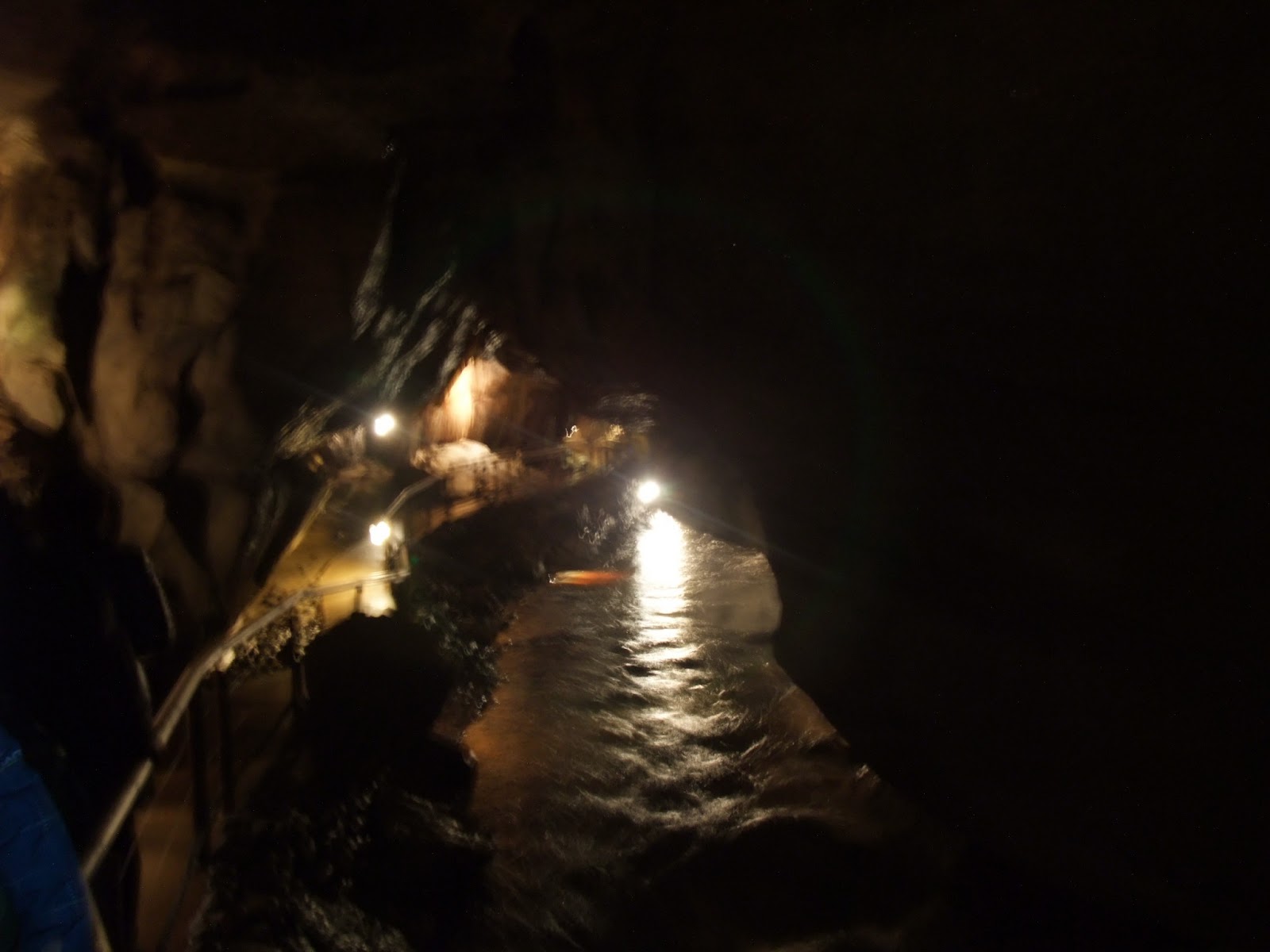
This is what a flooded cave looks like.
From the caves, it was a long, wet drive to the hotel. We passed into the Republic of Ireland and I had to switch my bikes dashboard over to 'km/h' rather than miles per hour. Driving in km/h was strange, primarily because speeds that you would usually do on roads in the United Kingdom suddenly seem obsolete. There appear to be only two types of driving in the Republic of Ireland; dangerously quick or painfully slow. Some towns implemented a speed limit of 30 km/h which is about 19 miles an hour and I found myself riding my clutch just to keep from stalling, it was that slow. The unusual thing was that the speed limits outside of the towns were around 100-120 km/h. This is between 60 and 70 mph; far too quick for most of the narrow, bendy lanes that lay outside the towns.
After getting drenched, I set my stuff to dry in the hotel, got changed and headed out to see the burial mounds of Tulsk. I would include the pictures of them here but as my girlfriend helpfully reminded me, "they just look like mounds of dirt." Even though some these mounds of dirt are older than the pyramids, I can't help but feel that pictures don't quite do them justice. The other reason I had headed to Tulsk was to see the 'cave of cats'. Pictures of this online show that is is a tiny opening in the middle of a field which opens out into a truly remarkable and interesting cave complete with inscriptions and an etching by the first president of Ireland.
To ensure that I found this cave, I inputted some co-ordinates into my trusty Chinese sat nav and set off to find them. Unfortunately, the only coordinates I could find were from some hippy website where 'druids' were banging on about the spiritualism of the place. They also stated that the cave of cats could be seen from the nearest burial mound and was 'impossible to miss'. I daresay that I should've considered the possibility that 'druids' probably don't know what coordinates are and as such, trusting people who believe that stones have energy and stars talk to them was foolish on my part. Needless to say, I did not find the cave of cats despite searching high and low. One set of coordinates wanted to lead me 50 km in another direction whilst the other set wanted me to climb a barb wire fence, trespass through a farm and then head into a field of angry-looking cows 200 metres beyond. Fuck you, hippies. Fuck you very much.
At least my disappointment was drowned at a nearby pub where we experienced our first taste of the wonderful hospitality of the Irish.
On the third day, I set off for a part of the trip that I had very much been looking forward to. The village of Doolin and the Cliffs of Moher. The weather was dry and sunny and the ride was wonderful. I set off from the hotel and took the road down towards Galway before stopping at a petrol station for some 'Emo oil'. I don't want to be accused of a hate crime, but this petrol was cheaper than the stuff in the UK so I can only assume it comes from the grease squeezed from the hair of emos. Regardless, it powered my bike quite well:

The man at the petrol station was incredibly friendly and helpful. Not only did he talk to me about my trip so far but he also recommended a different route to Doolin that would take me on one of the best roads I have ever driven along. I took his advice and reprogrammed my sat nav to take us along the west coast. This drive was stunning and took us through 'The Burren', a unique karst (limestone) landscape and past plenty of ruins:


The drive also took us to where the Burren met the coast and there were some truly wonderful cliffs to be seen. One of the more surprising things about the whole of my trip around Ireland was how good the roads were. Here in the UK, our road tax simply pays for politicians to go on holiday and buy hookers but in Ireland, it seems that they actually surface the roads correctly. Even on the country roads, there were few potholes and generally they were smooth and safe to ride on.
After making it to Doolin, we went to visit the magnificent Cliffs of Moher. The coast near Doolin is battered by the Atlantic and this has resulted in spectacular 70 metre high vertical cliffs called the cliffs of Moher. It was a little sad to see 'Samaritans' signs up all along the coast, indicating that not everyone comes to the cliffs for the view... a view that was truly stunning:


After visiting the cliffs and the visitors centre (which looked like a futuristic Bag End), we headed into Lahinch for my first Irish Guinness and a wonderful seafood meal. I hate to sound like one of those people who try to appear more cultured because they've tried something from outside the UK, but Guinness really does taste nicer (on the whole) in Ireland. Rather than that bitter aftertaste you get here in England, their version is smoother and doesn't taste quite so much like you've been gargling on a cows testicles.
After quite a terrifying night of strong winds that seemed to threaten me with the prospect of being torn from this Earth and sent on an adventure with scarecrows and lions of a questionable sexuality, I set off on the fourth leg of my trip. It was a truly glorious day of sunshine and low winds so I took a detour to the nearby Paulnabrone Dolmen for a photo:

Devil horns scare off hippies
From here I had a truly stunning drive to the city of Cork along the first stretch of motorway I had encountered in Ireland. This was where I realised that my trust sat nav might not be entirely up-to-date as it proceeded to freak out whilst I zipped across the landscape like a bird, following no road that was known to it. It spazzed out and tried to fix my position to somewhere it understood but could find no luck, especially as I went through a tunnel that took me under a large river. As I had not bought a set of earphones nor successfully linked the device through Bluetooth, I did not have the audio turned on but I would like to believe that at this time, the device was saying (In a Chinese accent), "Oh no, you are not on a road! How are you flying? Please stop! You are now underwater and are probably dead."
During my drive south, I realised something that I couldn't quite put my finger on earlier in the trip. There was 'something' about the trip that made it far more enjoyable than driving around the UK and I finally understood what it was. Irish drivers seem to like bikers. Every time I was behind a car they would pull over slightly to let me past, even though I was not making any attempt to overtake them. The roads were far more empty than English roads anyway, but this just made the driving even more special.
Near Cork, there were some beautiful ruins of a Priory that were just sitting in a nearby field so I had to stop for some pictures. It turned out to be called Ballybeg Priory and it had one of the best examples of a medieval dovecot in Europe. A dovecot is simply a place where priests kept pigeons. I guess not everyone would be excited by this, but it was remarkable to see an old building in such good condition:


The Priory, dovecot, and inside the dovecot
After the short stop, I drove on to Cork and was immediately concerned. Everyone was running. I thought it might have been the start of the zombie apocalypse, but the people were all in running gear, indicating that they were running for fun. I really liked Cork and it seemed like there was lots to do so I still don't understand why there were lots of runners out that day but it was not boredom that was driving them to such madness.
Before settling down for the night, I took a short drive to the town of Cobh which is on the outskirts of Cork city. It was a really nice little town with colourful houses... kind of like the kids TV show Balamory but without the pink castle. It was in Cobh that I realised that Irish hospitality is not just reserved for the bars. We visited a Cantonese restaurant and as soon we sat down, a menu was given to us along with a big jug of water, two glasses and a generous portion of prawn crackers. This was before we had even ordered. When our order was taken and it was noticed that the prawn crackers had dwindled in number, the waitress asked whether we wanted more.
I could've cried. NEVER have I been asked if I wanted more prawn crackers with a meal. I could've married that girl on the spot. She and my Chinese sat nav would've got on well.
I could've cried. NEVER have I been asked if I wanted more prawn crackers with a meal. I could've married that girl on the spot. She and my Chinese sat nav would've got on well.

Cobh, AKA Balamory
After a lovely meal and a walk along the promenade, it was back to the hotel for sleep.
On the next day, we were originally going to go on a whale watch but this had been cancelled due to bad seas and this should've been a warning of the day to come. Instead, I drove from Cork to the nearby Blarney Castle. Blarney Castle is famous for a stone. A stone that everyone kisses. The stone is not easily kissed either, it is right atop the caste on the apex of a ledge that overhangs a large drop. Kissing the stone is meant to give you 'the gift of the gab' (the ability to talk anyone around to your way of thinking). I really don't know who first found that out or what sick thoughts were going through their head ("I want to love this castle as only a man can"), but it has been the claim ever since. Suffice to say, I didn't kiss the stone because I talk enough as it is. It is likely the universe would explode if I kissed it... or it would take away my wit and leave me with nothing but my questionable looks to get by with.

My girlfriend kissing the Blarney stone... and yes, she has a head, I know because she loses it a lot with me.
In the grounds of the castle were many trees, a river and a poison garden which gave a really interesting insight into common poisonous plants that can be found in the UK and Ireland (for example, I never knew rhubarb was poisonous). In hindsight, we probably should've spent longer at the castle, but alas I came up with the idea of another drive to see another set of cliffs and this would prove to be problematic.
We set off from Blarney castle around midday and started a long drive towards the south west coast with our ultimate destination being a place called Mizen Head. These cliffs are said to be dramatic and geologically interesting and I very much wanted to see them. Unfortunately, an hour into the drive, it started raining very heavily and the winds really picked up. The scenery was fantastic but as I drove through a narrow pass and emerged on the other side, I faced probably the only bad road in Ireland. This was windy and covered with sharp gravel. I took my time but as I reached the bottom of the slope I had the sudden realisation that my back tyre was completely flat. It happened suddenly but because I was aware of what had happened I managed to stop safely. Before I even got off the bike I knew what the problem was.
We set off from Blarney castle around midday and started a long drive towards the south west coast with our ultimate destination being a place called Mizen Head. These cliffs are said to be dramatic and geologically interesting and I very much wanted to see them. Unfortunately, an hour into the drive, it started raining very heavily and the winds really picked up. The scenery was fantastic but as I drove through a narrow pass and emerged on the other side, I faced probably the only bad road in Ireland. This was windy and covered with sharp gravel. I took my time but as I reached the bottom of the slope I had the sudden realisation that my back tyre was completely flat. It happened suddenly but because I was aware of what had happened I managed to stop safely. Before I even got off the bike I knew what the problem was.
I never lose my head in stressful circumstances so I simply sought shelter next to a nearby bush and dialled the RAC (who thankfully covered travelling in the Republic of Ireland). They were prompt and stated that someone would be with us within an hour. I was thankful for this speed because we had broken down literally in the middle of nowhere with only sheep and the driving wind and rain for company. This was my third encounter with the famous Irish hospitality as a local stopped to help us with directions and was happy to take my girlfriend to a nearby village for some food supplies whilst I waited with the bike. It was not a long wait until the RAC arrived and towed me to a nearby town to await another pick up to get us back to Cork.
I was drenched and cold so I went to nearby pub and was again surprised by how friendly the locals were. They all spoke to me about my trip so far and they started an open fire so I could hang my things up to dry in front of it. I enjoyed a few drinks and was able to relax until the tow truck arrived to take us back to Cork.

I will be forever thankful for this fire.
After a needed sleep, I woke up and had to book my bike into a nearby shop for a new tyre and what would end up being a new chain as well. I count my blessings on this as the store noticed my bike chain was loose and could not be tightened any further. It was a little dangerous considering we now faced a long drive to Dublin so the shop fitted a new chain whilst I looked around Cork.
Despite losing half a day to repairs, I was refreshed and ready for the drive to Dublin. The only problem was that I was setting off far later in the day than I had wanted and as such, the weather started to turn. I'm not going to lie when I say it was one of the most unpleasant drives of my life. My Chinese sat nav spent most of the time confused because the motorway was not on its map and there was the intermittent toll booth which meant a struggle with money before I could get through. On one occasion the bar would not lift to let me past so I had to press a button for assistance only to have a distorted Irish voice come over the speaker. From within my helmet I yelled a muffled response about the bar not lifting and I didn't hear his reply. Eventually, he got bored and simply lifted the bar for me.
Finally, cold and wet, I got to Dublin and was able to settle down for the night. The next day, I headed into the city to see the sights. I'm not a fan of most cities as I prefer countryside and beautiful scenery over concrete and people but Dublin was a nice place to visit. My only gripe? There are literally about two cash machines in the whole of Dublin and getting to them is a quest in itself. After a half hour walk and multiple curses, I found a cash machine upstairs in a Debenhams store by the lift at the very back of the shop in a little hallway (obviously, where else would you keep a cash machine?). Knowing that I probably wouldn't see another cash machine until I was back in the UK, I opted to draw out 'all the money' and from here headed to the Guinness Storehouse/Museum.


The Guinness Storehouse was really interesting as well as being a place where people went with the intention of drinking as much as they possibly could. Apparently there had previously been a rule whereby you could drink as much as you wanted in 10 minutes at the end of the tour round the museum. This has since been replaced by a more intelligent/cruel rule of having a free Guinness voucher and getting to taste another half on the way around. At the end of the museum you can learn how to 'pour the perfect pint' and then enjoy said pint in either the restaurant or Gravity Bar. The restaurant sells Guinness pies and stews as well as more Guinness to drink. I did get to see the Gravity Bar which offered a full 360° view of the city but it was also packed with some very drunk people. After a crude conversation with some guys and an invitation to their stag do (which I politely did not take up) we left the museum through a bizaare hall of mirrors with the music from the Guinness commercial playing:
... and yes, there were drunken people dancing like that man in the hall, just to make it a bit more surreal to an already alcohol-dulled mind.
The rest of my time in Dublin was spent drinking in pubs so it was relaxed and well-earned after a week of driving. I didn't drink so much as to have a bad head the next day which was fortunate because I had a couple more stops before the trip was at an end.
I was glad that the weather was far more pleasant on the drive from Dublin back up toward Belfast and even more glad that I had stops to break up the journey. The first was at a place called Bru na Boinne or 'Bend of the Boyne' which is an archaeological site located in County Meath next to the River Boyne. It consists of multiple sites, but the two we visited were Newgrange and Knowth.
Newgrange is a huge mound and passage tomb with a reconstructed front. The man who led the tours had very strict rules and a unique way of describing the site but he was an excellent guide who was also surprisingly funny. Photos could not be taken within the tomb but were permitted outside. In addition to the tomb and mound, there were multiple examples of stone age rock art which is apparently some of the finest in the world:


Every year on the Winter Solstice, light shining into the passage tomb through a small 'window' has a funky effect of illuminating the whole tomb. People can opt to see this but have to be put into a 'lottery' and only a small number are fortunate enough to win. Thankfully, the effect was demonstrated to us using a bulb.
After Newgrange, we took the tour bus to Knowth, another site in the area where there were multiple mounds and passage tombs surrounding a single huge one. There was more evidence of Megalithic stone art at this site and you were allowed to take photos inside... but the guide wasn't quite so interesting as the man at Newgrange. Although nobody knows what the stone art means at these sites, the guides said that you could find your own meaning in the art:

I found boobs
I guess its not the kind of site that would interest everybody, but it was a really nice place to visit for anyone with an interest in archaeology, mounds of dirt or stone art.


From Newgrange it was the last leg of the journey. I drove north towards Belfast and was treated to some wonderful sites of the mountains ahead as I made my way through countryside and small villages. Before going back to Newcastle to drop my girlfriend off, I wanted to make one final stop at a location where Game of Thrones is filmed: the beautiful Tollymore forest. It is easily recognisable from the series as pretty much any scene in the Northern woods and I can see why it was chosen for filming. The forest floor is thick with moss and there are numerous streams and a river that runs through the woods. It really is a lovely place and I only wished I had had more time to spend there... ideally with a BBQ and some drinks.


After Tollymore it was goodbye to Ireland and one final chance for the Chinese sat nav to prove its worth. On my way to Belfast from Newcastle, the main road I was travelling along was blocked by the Police (Garda) due to an accident. I didn't know it at the time but a bus full of wedding guests had tipped up along the road and the route had been closed all afternoon. I was running a little bit late and risked missing my ferry so I trusted the device to recalculate a route. Thankfully, it performed very admirably and I made it to my ferry in the nick of time.
I had a very enjoyable time in Ireland and I learned that the people really are as friendly as everyone says (and it doesn't feel forced either; they genuinely are nice). Also, it is a beautiful country with much history and the Guinness really does taste better. I joked on my return that every street has a pub, every village has a church, every town has a castle and every city has a harbour but that was truly my experience of Ireland. I know it's had its troubles in the past but I would recommend that everyone visit.
... and if you're going to visit, do it on a motorbike with a cheap Chinese sat nav because they really are fantastic!


 Posts


